 Illustration by Mark Baker-Sanchez/Rachel Pickus; Adobe StockSave this storySave this story
Every other week or so, I treat myself to a slab of Levain’s chocolate chip banana bread. The ladies who work at my local one are always friendly, always game for a brief chat. I came in one week wearing a variety of jewel-toned, cat-eye polishes on my nails, and they ooh’d and ahh’d over them, asking me to turn my hands so they could see the blue-to-purple, iridescent shift.
“I want those so bad, but we’re not allowed to wear nail polish here—it could chip into the batter,” one of them said sullenly, holding her hand out in front of her, sporting short, bare nails. Little did she know, she was very much on trend.
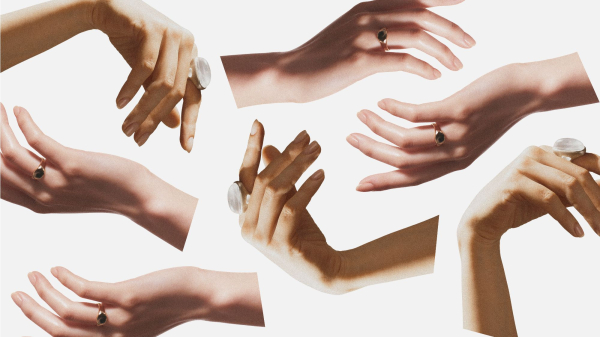
Bare nails seem to boomerang around in the culture every other year as a sort of palette cleanser. It’s a routine reminder that it’s fine to take a break with manicure culture in the face of increasingly intricate and expensive nail art taking over the beauty trends. The discourse has taken many amusing and elaborate directions. But the newest spin on trimmed and polish-free nails is that they’re a symbol of wealth and status, according to a handful of social media influencers. How exactly? The reasoning is that high-status, wealthy people are too busy to bother with the regular, hours-long nail appointments and fussy maintenance that expensive manicures require (girlboss propaganda if I’ve ever heard it). There’s also conjecture that mass adoption of manicures (specifically, the kinds that embody like the 💅 manicure emoji: medium-to-long length, feminine) has become overstyled and gauche. A non-manicured, well-groomed hand is a countersignal indicating the status to opt out of such mainstream rituals.
This is a lot of overthinking about not wearing nail polish, if you ask me. It implies that wearing nail polish is the default norm, which, if you consider the entire population, is patently false. But the quiet part of this new repackaging of bare nails as status flex is how it implies the opposite: colorful, expressive nails are low-status. This is not necessarily a new sentiment for those familiar with the intersectional politics of beauty amongst non-white cultures. Classism and particularly anti-Black racism have consistently stigmatized long, colorful, acrylic nails as unprofessional and “ghetto” when worn by Black and Latino women (while similar nail styles are celebrated as cool and trend-setting on white women). Nail art and salon culture have deep roots in Black, Latino, and Asian-American history; they’re a meaningful form of creative self-expression amid community, despite their imperialist origins and the respectability politics that determine whose nails are tasteful and whose are tacky. There’s quiet luxury, and then there’s quiet discrimination.
The quiet part of this new repackaging of bare nails as status flex is how it implies the opposite: colorful, expressive nails are low-status.
“It’s harmful to conflate naked nails with taste or class, which are often just euphemisms for white supremacist beauty standards,” beauty writer and Allure contributor Kristina Rodulfo says in an Instagram Reel expressing her beef with this new resurgence of bare nails propaganda.
As far as bare nails fall into beauty hierarchies, they are, ostensibly, the baseline for indicating health, hygiene, and good grooming. Having clean, trim nails is often a uniform requirement for service and care workers, like nurses, cleaning staff, and food handlers (who are often people of color). Most people I know who keep their nails bare do so for work-related reasons. And conversely, most people I know who commit to regular manicure appointments and nail maintenance also cite work reasons: They want to appear polished and put together. If both are valid, are either of them valid? And why do people have such strong feelings about nails and their relationship to a person's net worth?
Early in my career as a beauty writer in the 2010s, I contributed to a website that involved original photography, often of myself demonstrating beauty tutorials. It was made very clear from the commenters that chipped or worn nails were “distracting” and ruined a look (even if it was a makeup or hair tutorial that had nothing to do with my nails). If I didn’t have polish on, that also elicited accusations of laziness or dismay at my “incomplete” appearance. At the time, I remember thinking, “Who cares??” But as I watched beauty YouTubers and Instagrammers come to define the new digital beauty culture, I noticed they always had their nails done. The implicit expectation was that if you’re on screen, your nails must be camera-ready.
To be clear, the bare nails we’re seeing on influencers, red carpets, and runways still require making an effort. Even when so-called naked manicures are on the mood board for editorial and commercial shoots, there’s almost always a manicurist on set to file, shape, buff, and make the models’ hands look as flawless as possible. (As writer Bella Gerard pointed out in her “No one in Vogue gets their nails done anymore” Substack post, even an at-home non-manicure requires multiple products to get that “clean girl” look everyone’s raving about.) I asked my friend Stephanie Stone, an editorial nail artist, for her thoughts on this. “For as long as I’ve been doing this, 80 percent of the nail direction on set has always been clean, sheer, or buff,” she told me. “I feel like that’s more so the photos aren’t dated to an era, versus having a nail look that’s very identifiable within a trend timeline.” Practicality prevails once again.
A clear perk of bare nails being on trend now is that skipping manicures will save time and money. Manicures are expensive, especially if you’re doing gel, which most people I know are. In New York City, any kind of specialization or nail art is at least a three-dollar-sign price point before tip. So when bare nails were declared in again, my recession indicator alarm bells went off.
And that’s partly why this conflation of wealth and status makes this “trend” so confounding to me. These kinds of contradictions are unique to this era of effortless, “clean girl” beauty — an aesthetic whose popularity, rather than celebrating one’s unadorned and authentic appearance, launched a cavalcade of beauty products towards the pursuit of a specific iteration of effortless and clean: one that veers overwhelmingly white. When an aspirational lack of effort requires a whole production to achieve it, you must call it what it is: propaganda. It’s Beauty™ in service of order, not expression — the kind of beauty that is a byproduct of “preferences that reproduce the existing social order,” as sociologist Tressie McMillan Cottom writes in her essay collection, Thick.
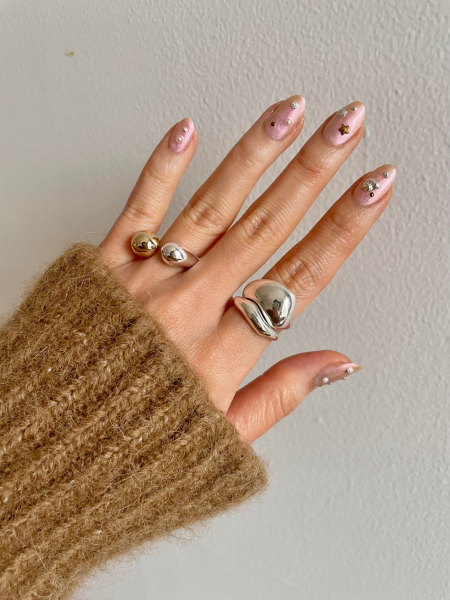
One of the author’s recent at-home manicures.
Courtesy Sable Yong
I’ve enjoyed doing my own nails since I was a kid. Initially, it was out of financial necessity, but I also happen to be blessed with steady hands and exceptional fine motor skills. Mostly, I keep doing it because I love it. It’s my favorite creative activity to do for myself. Sometimes I’ll do intricate nail art, and sometimes I’ll keep it demure with something sheer or nude. I’ve never been treated any differently when I’ve been bare-nailed, but I suppose in our current hyper beauty culture, it may be refreshing for some people to see evidence that not everyone subscribes to polished perfection.
I’m sure many wealthy people do favor bare, short nails. It’s possible that they prefer spending their money on things other than manicures, despite being able to afford them. The next time I meet a millionaire with bare nails, I’ll be sure to ask them. In the meantime, I remain skeptical when viral testimony is driving culture. Too often, new or rehashed beauty trends reinforce outdated and limiting beauty ideals when left uninterrogated. (Remember when TikTok’s red nail theory had everyone reaching for crimson at the salon?) We often cheer on the beauty trends that serve us, but it’s worthwhile to consider how their impact further alienates others.